
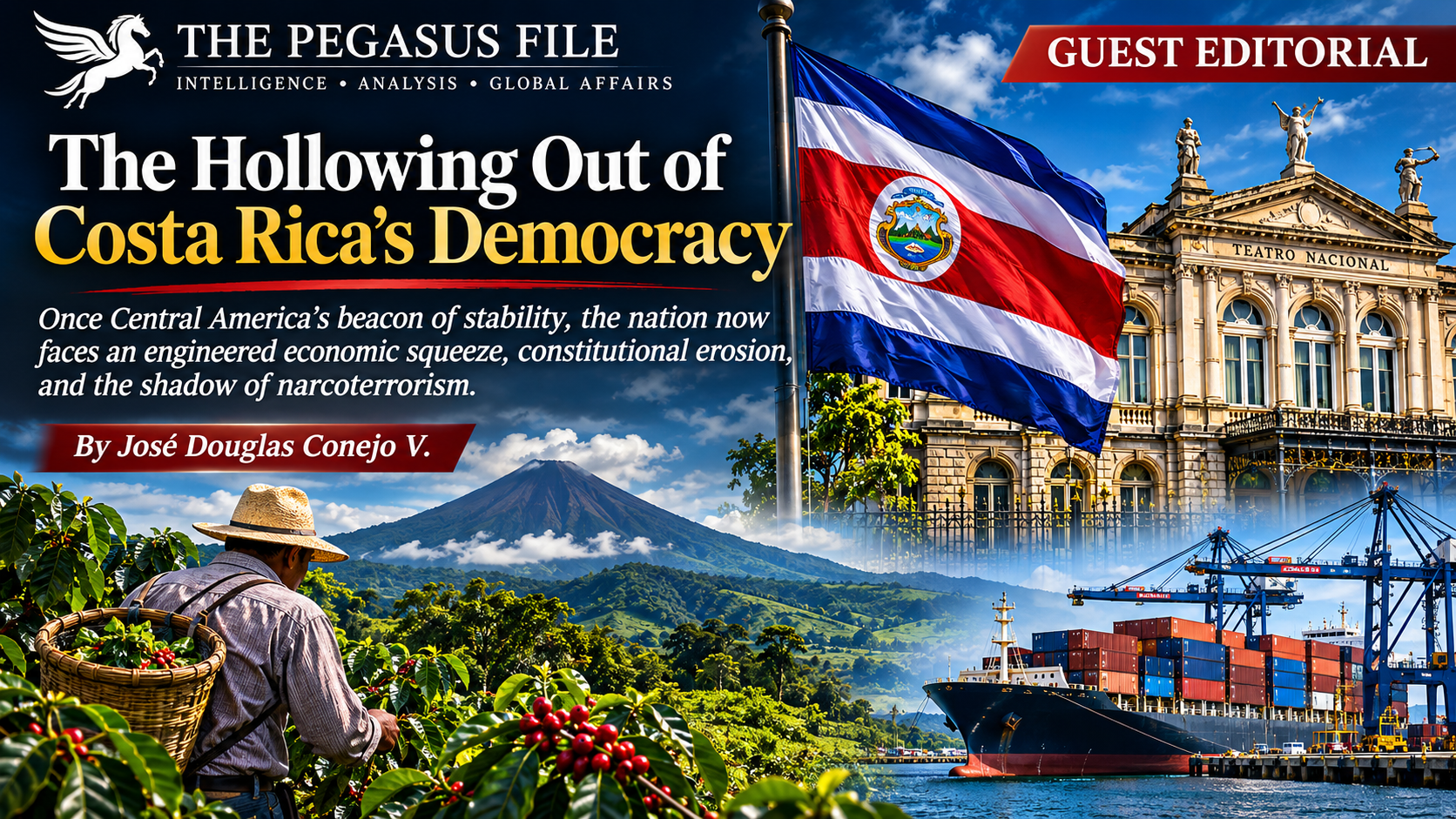

The Hollowing Out of Costa Rica’s Democracy
Once Central America’s beacon of stability, the nation now faces an engineered economic squeeze, constitutional erosion, and the shadow of narcoterrorism.
By José Douglas Conejo V.
For decades, the Republic of Costa Rica stood as a democratic beacon for the world. Yet, since the rise of globalist populism, there has been a concerted effort to reduce this democratic legacy to shallow branding, such as being labeled “the happiest country in the world.”
This shift was followed by sweeping institutional reforms regarding LGBTQ rights, including the legalization of same-sex marriage. Rushed through the legislature on a wave of political populism, the law failed to properly establish the legal grounds for separation and divorce. Because of legislative negligence, it now falls to the Judiciary to define—through case law—fundamental legal concepts such as “protected spouse” within same-sex unions. Once this brand of manipulative populism achieved its political goals, it faded away like any passing fad.
The Rise of Chavismo
From the very party that championed that agenda—the Citizens’ Action Party—the economic elites behind this populist wave broke away. They joined forces with their counterparts from the Social Christian Unity Party and a specific faction of the National Liberation Party, giving rise to Chavismo.
Chavismo is a revealing political phenomenon. At its inception, it carried no political baggage because its standard-bearer, Rodrigo Chaves Robles, had never served in a prior administration—allowing the movement to find fertile ground. He incited hostility against the press, openly threatening to shut down Telenoticias and La Nación, the country’s flagship television network and newspaper of record, and his voters remained indifferent.
Chaves cultivated the persona of a heavy drinker—loose-tongued and belligerent, seemingly eager to pick a fight with anyone who opposed him. When his background came under scrutiny, it surfaced that he had been dismissed from the World Bank for sexually harassing several female subordinates, including disturbing allegations that he had suggested acts of bestiality to one of his accusers. Rather than disqualifying him, the combination of alcohol, womanizing, and vulgar rhetoric resonated with working-class voters, who naively handed him the presidency. Years of creeping populism had finally borne fruit.
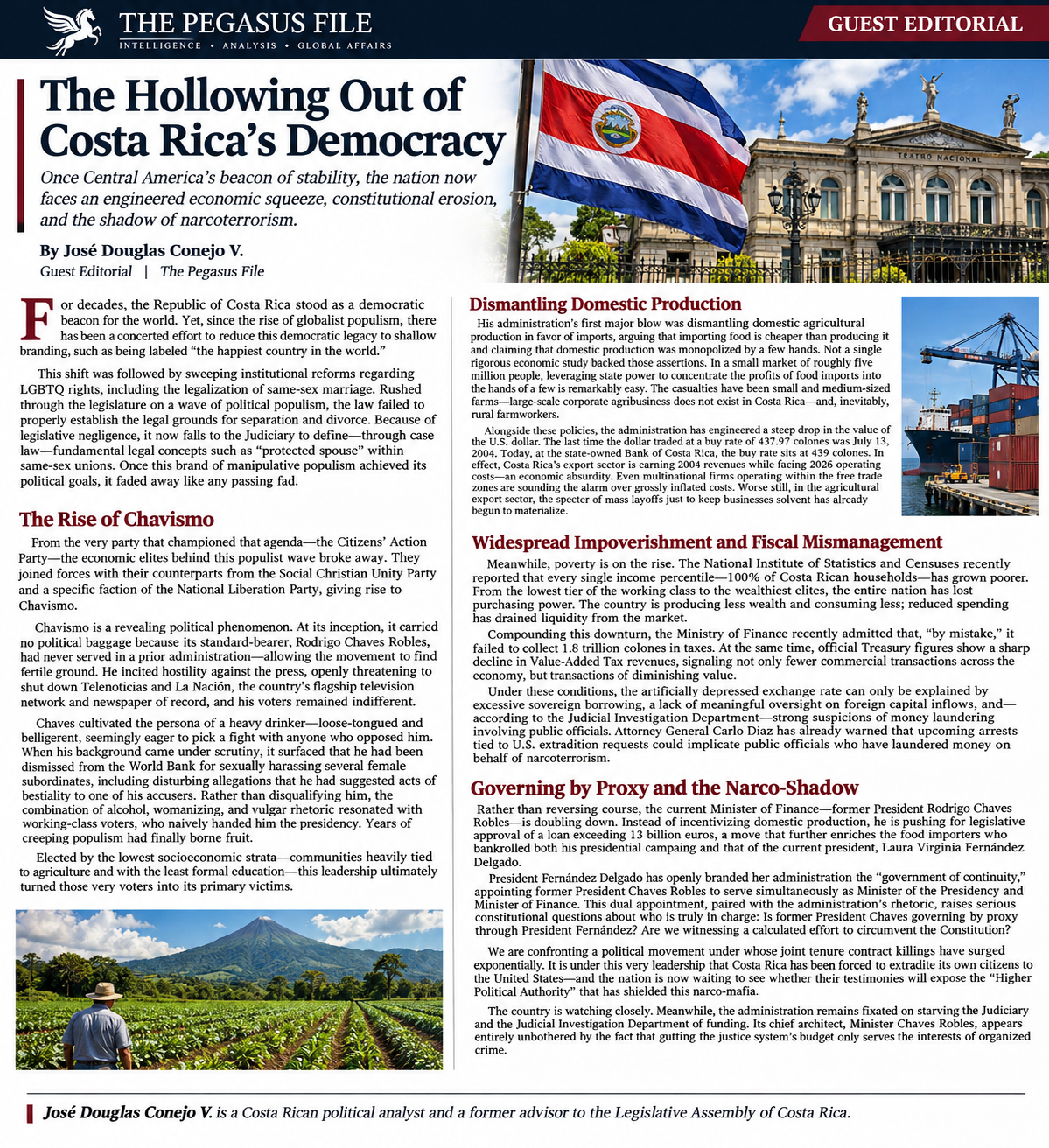
Elected by the lowest socioeconomic strata—communities heavily tied to agriculture and with the least formal education—this leadership ultimately turned those very voters into its primary victims.
Dismantling Domestic Production
His administration’s first major blow was dismantling domestic agricultural production in favor of imports, arguing that importing food is cheaper than producing it and claiming that domestic production was monopolized by a few hands. Not a single rigorous economic study backed those assertions. In a small market of roughly five million people, leveraging state power to concentrate the profits of food imports into the hands of a few is remarkably easy. The casualties have been small and medium-sized farms—large-scale corporate agribusiness does not exist in Costa Rica—and, inevitably, rural farmworkers.
Alongside these policies, the administration has engineered a steep drop in the value of the U.S. dollar. The last time the dollar traded at a buy rate of 437.97 colones was July 13, 2004. Today, at the state-owned Bank of Costa Rica, the buy rate sits at 439 colones. In effect, Costa Rica’s export sector is earning 2004 revenues while facing 2026 operating costs—an economic absurdity. Even multinational firms operating within the free trade zones are sounding the alarm over grossly inflated costs. Worse still, in the agricultural export sector, the specter of mass layoffs just to keep businesses solvent has already begun to materialize.
Widespread Impoverishment and Fiscal Mismanagement
Meanwhile, poverty is on the rise. The National Institute of Statistics and Censuses recently reported that every single income percentile—100% of Costa Rican households—has grown poorer. From the lowest tier of the working class to the wealthiest elites, the entire nation has lost purchasing power. The country is producing less wealth and consuming less; reduced spending has drained liquidity from the market.
Compounding this downturn, the Ministry of Finance recently admitted that, “by mistake,” it failed to collect 1.8 trillion colones in taxes. At the same time, official Treasury figures show a sharp decline in Value-Added Tax revenues, signaling not only fewer commercial transactions across the economy, but transactions of diminishing value.
Under these conditions, the artificially depressed exchange rate can only be explained by excessive sovereign borrowing, a lack of meaningful oversight on foreign capital inflows, and—according to the Judicial Investigation Department—strong suspicions of money laundering involving public officials. Attorney General Carlo Díaz has already warned that upcoming arrests tied to U.S. extradition requests could implicate public officials who have laundered money on behalf of narcoterrorism.
Governing by Proxy and the Narco-Shadow
Rather than reversing course, the current Minister of Finance—former President Rodrigo Chaves Robles—is doubling down. Instead of incentivizing domestic production, he is pushing for legislative approval of a loan exceeding 13 billion euros, a move that further enriches the food importers who bankrolled both his presidential campaign and that of the current president, Laura Virginia Fernández Delgado.
President Fernández Delgado has openly branded her administration the “government of continuity,” appointing former President Chaves Robles to serve simultaneously as Minister of the Presidency and Minister of Finance. This dual appointment, paired with the administration’s rhetoric, raises serious constitutional questions about who is truly in charge: Is former President Chaves governing by proxy through President Fernández? Are we witnessing a calculated effort to circumvent the Constitution?
We are confronting a political movement under whose joint tenure contract killings have surged exponentially. It is under this very leadership that Costa Rica has been forced to extradite its own citizens to the United States—and the nation is now waiting to see whether their testimonies will expose the “Higher Political Authority” that has shielded this narco-mafia.
The country is watching closely. Meanwhile, the administration remains fixated on starving the Judiciary and the Judicial Investigation Department of funding. Its chief architect, Minister Chaves Robles, appears entirely unbothered by the fact that gutting the justice system’s budget only serves the interests of organized crime.
José Douglas Conejo V. is a Costa Rican political analyst and a former advisor to the Legislative Assembly of Costa Rica.