
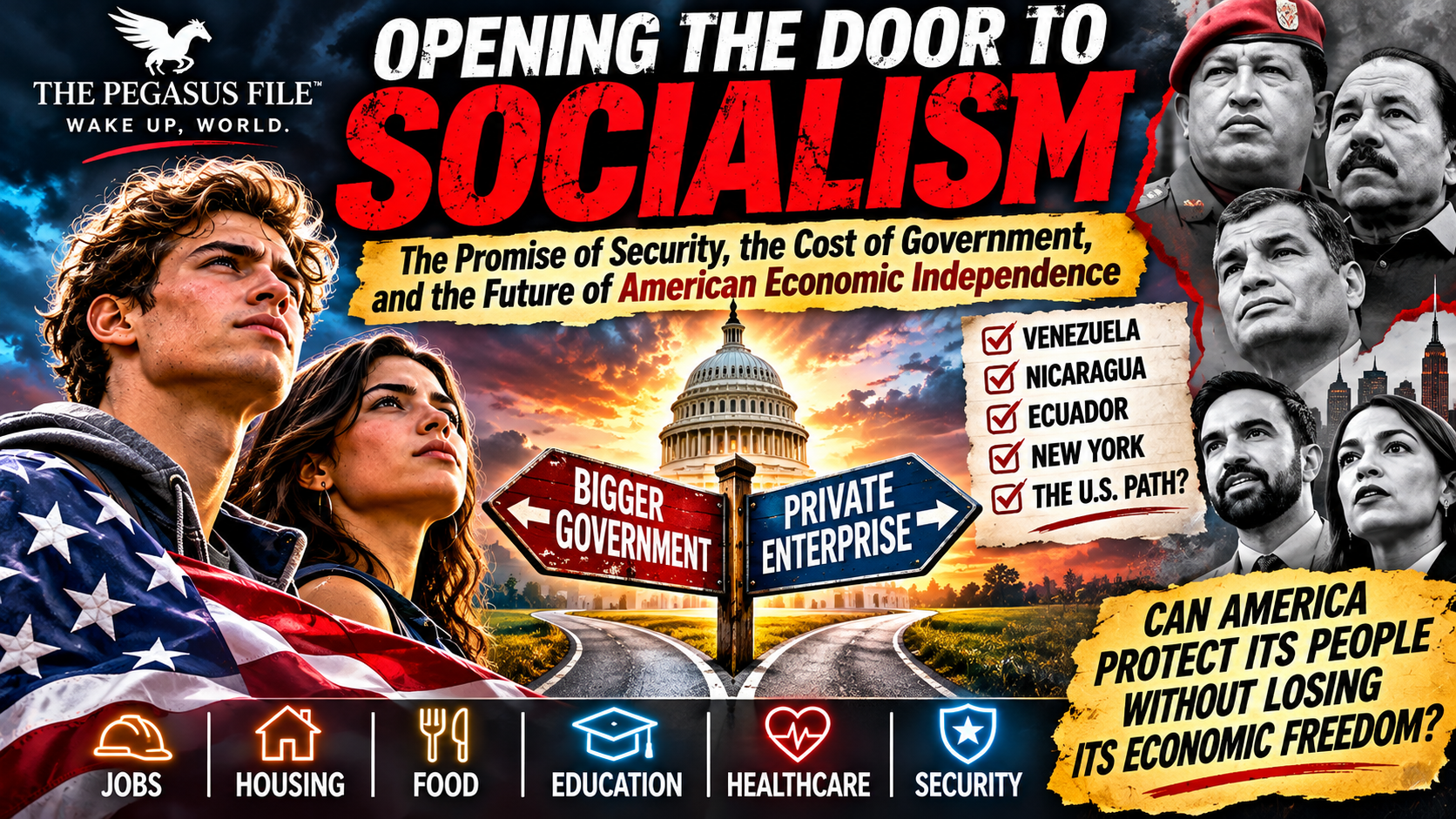
The Promise of Security, the Cost of Government, and the Future of American Economic Independence
THE PEGASUS FILE | SPECIAL EDITORIAL & POLITICAL ANALYSIS
By Chip Tatum | November 5, 2026
The Promise
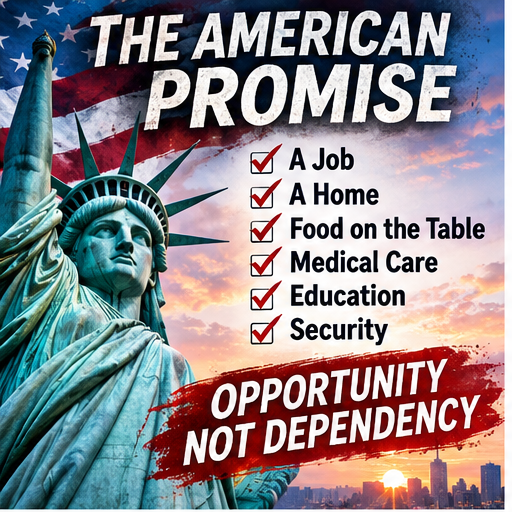
Throughout modern political history, candidates have won public support by promising to improve the economic security of ordinary citizens.
Employment. Affordable housing. Food on the table. Medical care. Education. Public safety. A more secure future for the next generation.
These are not unreasonable aspirations. They are among the most fundamental concerns of any society.
The political question is how governments intend to deliver them, how they will pay for them, and what happens when temporary promises become permanent obligations.
Socialism offers one approach through greater public ownership, redistribution, and government intervention. Capitalism offers another through private ownership, investment, competition, and market activity.
In practice, most modern economies combine elements of both.
But the distinction between a government that creates opportunity and one that becomes the primary source of economic survival deserves serious examination.
Political movements have long understood that economic insecurity creates an opportunity to gain public support. A candidate promising immediate relief from unaffordable housing, stagnant wages, expensive medical care, or unemployment can appeal to people who believe existing institutions have failed them.
The promises may be sincere. They may also be politically effective.
The challenge begins when the campaign ends and governing begins.
The Cost of the Promise
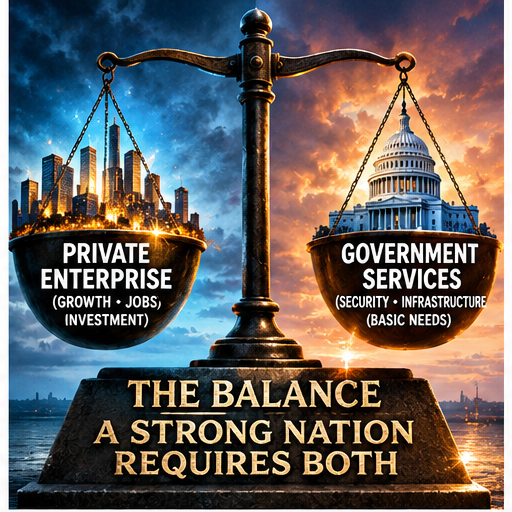
Every permanent public program requires resources.
Those resources generally come from taxation, borrowing, public assets, natural-resource revenues, or some combination of these sources.
A government may promise expanded employment, subsidized housing, free transportation, public medical services, or direct financial assistance. But these programs carry administrative costs, staffing obligations, infrastructure requirements, and long-term financial commitments.
Taxation is necessary for functioning government. The question is whether taxes are designed and administered in ways that support economic activity or unintentionally discourage it.
Businesses evaluate labor costs, taxes, regulatory requirements, infrastructure, security, and the predictability of government policy before investing.
When the combined burden becomes excessive, investment may slow, companies may relocate, and private employment opportunities may suffer.
Yet the opposite is also true: inadequate infrastructure, weak education, poor public health, and insecurity can discourage investment just as effectively.
The issue is not whether government should exist in the economy. It must.
The issue is whether government spending creates lasting economic capacity or simply increases obligations that future taxpayers must support.
Venezuela: Hugo Chávez and the Politics of Redistribution
Hugo Chávez came to power promising to redistribute Venezuela’s oil wealth, challenge entrenched political interests, and expand public services.
His government funded extensive social programs, expanded state involvement in the economy, and used petroleum revenues to support ambitious domestic commitments.
During periods of high oil prices, those revenues helped finance programs intended to improve access to healthcare, education, and basic goods.
But dependence on petroleum income also created significant vulnerability.
As state intervention expanded, Venezuela experienced growing institutional conflict, pressure on private enterprise, economic distortions, and increasing political concentration.
Later governments faced a combination of falling oil production, economic mismanagement, sanctions, monetary instability, and collapsing public confidence.
The resulting crisis cannot be explained by a single policy or event.
Nevertheless, Venezuela demonstrates the danger of constructing extensive permanent obligations around volatile revenue while weakening the institutions responsible for economic accountability.
A government can promise economic security while simultaneously undermining the productive capacity required to finance it.
Nicaragua: Daniel Ortega and Political Dependency
Nicaragua presents a different but equally important case.
Daniel Ortega’s political career has combined revolutionary socialist origins with later arrangements involving private businesses, social programs, and concentrated political authority.
His government has maintained relationships with portions of the private sector while consolidating political control over public institutions.
The central concern is not simply the existence of social assistance.
It is what happens when access to government employment, public resources, contracts, or institutional protection becomes entangled with political loyalty.
A legitimate public program should serve eligible citizens regardless of their political opinions.
When benefits are distributed through patronage, citizens may become dependent not merely upon public institutions but upon the political organization controlling those institutions.
That distinction is fundamental.
Social protection and political dependency are not the same thing.
Ecuador: Rafael Correa and the Expansion of the State
Ecuador offers another instructive example.
Under Rafael Correa, the government significantly expanded its role in infrastructure development, public administration, education, and social spending.
Supporters credit his administration with major infrastructure investments and improvements in public services and poverty indicators during parts of his presidency.
Critics point to increasing public expenditure, growing fiscal obligations, expanded bureaucracy, constraints on political opposition, and corruption controversies.
Government employment and the creation of public institutions can provide needed services. They can also create long-term payroll obligations that must be supported through recurring revenue.
The difference lies in whether those institutions deliver measurable public value.
Public infrastructure can improve productivity. But projects with inflated contracts, weak oversight, or poor economic justification can impose substantial costs without producing comparable benefits.
Ecuador’s Sobornos 2012–2016 corruption case demonstrated the risks associated with improper relationships between government officials, political financing, and contractors.
Correa and other defendants were convicted in the case, although Correa has disputed the proceedings and their political motivations.
The broader lesson extends beyond any individual administration.
The larger the public budget and procurement system, the more essential independent oversight becomes.
Corruption is not unique to socialist governments. It occurs under governments of different ideological orientations.
But wherever public spending grows without adequate transparency, the opportunities for abuse grow with it.
The Employer: When Government Becomes the Job Market
Government employment is necessary.
Schools require teachers. Hospitals require medical professionals. Public security requires police officers, emergency personnel, and administrative support. Infrastructure requires engineers and inspectors.
The problem arises when public employment expands primarily to absorb unemployment or reward political relationships rather than to deliver necessary services.
A government job is not inherently less productive than a private-sector job.
But an expanding public payroll must be evaluated against the services provided, the government’s ability to finance it, and its effect on the wider economy.
Private enterprise generates employment through investment, consumer demand, production, and competition.
Government can support that process through infrastructure, education, predictable regulation, public safety, and the rule of law.
When government becomes the dominant economic employer, however, political decisions can acquire greater influence over individual livelihoods.
That creates a potential conflict between public service and political power.
The Contracts: Where Public Spending Meets Corruption
Government contracts are among the most consequential areas of public administration.
Roads, bridges, hospitals, schools, transportation systems, utilities, and public buildings all require significant expenditure.
Properly managed, these investments can strengthen the economy for generations.
Improperly managed, they can become vehicles for inflated pricing, favoritism, bribery, and political financing.
The public may see a completed project without knowing whether it was competitively priced or whether public officials benefited from its award.
A country does not become prosperous simply by spending more money.
It becomes more prosperous when that expenditure creates lasting public value.
Transparent bidding, independent audits, enforceable conflict-of-interest rules, and meaningful penalties for corruption are therefore essential parts of economic policy.
The Inheritance: Who Pays After the Political Promises?
Political administrations are temporary.
Government obligations can continue for decades.
A president, governor, or mayor may leave office while public debts, pension commitments, infrastructure maintenance costs, and permanent programs remain.
The incoming administration inherits those obligations.
This creates a recurring political temptation: announce immediate benefits while transferring part of the financial burden to future taxpayers.
Borrowing can be justified when it finances productive investments or responds to genuine emergencies.
But debt becomes dangerous when recurring expenses depend upon borrowing that cannot be sustained.
The proper measure of government performance is not simply how much was distributed or constructed during an administration.
It is whether the economy and public finances remain capable of supporting those commitments afterward.
The American Experiment: COVID-19 and Emergency Government
The COVID-19 pandemic created an extraordinary economic emergency.
Businesses closed, workers lost income, supply chains were disrupted, and governments faced pressure to prevent a much deeper economic collapse.
The United States responded with unprecedented relief programs, including direct payments, expanded unemployment benefits, business assistance, and other emergency measures.
Much of that assistance served legitimate purposes.
It helped households maintain spending, supported businesses, and provided income during a period when normal economic activity had been interrupted.
But the scale and speed of the programs also exposed serious weaknesses in federal oversight.
The Government Accountability Office estimated that pandemic unemployment insurance fraud likely totaled between $100 billion and $135 billion from April 2020 through May 2023.
The Small Business Administration’s inspector general separately estimated more than $200 billion in potentially fraudulent pandemic business assistance. These figures use different methodologies, and potentially fraudulent payments should not be treated as proven criminal losses in every case.
The problem was not simply that government provided assistance.
It was that massive amounts of public money moved through systems that were not adequately prepared to verify eligibility, detect fraud, and recover improper payments.
The pandemic therefore raises two separate questions.
First, how should government respond when an emergency temporarily prevents citizens from supporting themselves?
Second, how can government ensure that emergency assistance remains accountable, appropriately targeted, and temporary when the emergency ends?
From Emergency Relief to Economic Expectation
The pandemic also changed the relationship between many Americans and government assistance.
Programs that would once have been considered extraordinary became familiar parts of household and business finances.
This raises a question about whether repeated government intervention changes public expectations.
Do citizens increasingly expect government to offset every major economic hardship?
Or did the pandemic simply demonstrate that a functioning government must provide temporary support when normal markets cannot operate?
Those are different interpretations, and the evidence does not establish that emergency relief automatically creates permanent dependency.
The more useful question is whether public programs help people return to independent economic activity or create barriers to doing so.
Assistance should protect people during genuine hardship.
It should also preserve incentives and opportunities for employment, enterprise, and financial independence.
New York City: Democratic Socialism Meets American Government
The election of Zohran Mamdani as mayor of New York City in November 2025 brought democratic socialism into one of America’s most prominent executive offices.
His campaign emphasized affordability, including housing costs, transportation, childcare, and groceries.
These proposals appealed to voters confronting the high cost of urban life.
New York now offers an opportunity to examine what happens when an openly democratic-socialist candidate moves from campaigning to governing.
The relevant questions are practical.
How will proposed services be financed?
Which programs can be implemented through municipal authority, and which require state cooperation?
Will expanded public services reduce household costs?
How will tax and regulatory changes affect businesses, housing supply, and private investment?
And can the city maintain those programs without creating unsustainable financial obligations?
The answers require budgets, implementation records, and measurable outcomes.
A campaign victory establishes political support. It does not, by itself, establish economic success or failure.
Alexandria Ocasio-Cortez and the Next Generation
Alexandria Ocasio-Cortez represents another important development in American politics.
Her identification with democratic socialism, emphasis on economic inequality, and advocacy for expanded public services have made her a prominent figure within the progressive movement.
Her appeal reflects genuine concerns among Americans who struggle with housing expenses, medical bills, educational costs, and the difficulty of achieving financial independence.
Her potential future role in presidential politics deserves attention, although no presidential outcome should be assumed.
The larger issue extends beyond one politician.
A generation that doubts its ability to afford housing, build savings, or achieve the standard of living enjoyed by earlier generations may be more receptive to proposals for a larger government role in the economy.
Supporters argue that stronger public programs can expand opportunity and reduce the financial risks that prevent people from advancing.
Critics question whether the costs, taxes, and regulatory effects of those programs could reduce investment, economic growth, and personal independence.
Both arguments must ultimately be tested against results.
American democratic socialism also operates within a different constitutional, institutional, and economic environment from the systems developed under Chávez, Ortega, or Correa.
Those historical comparisons are valuable, but they do not establish that identical outcomes will occur in the United States.
George H. W. Bush: The Politics of Economic Security
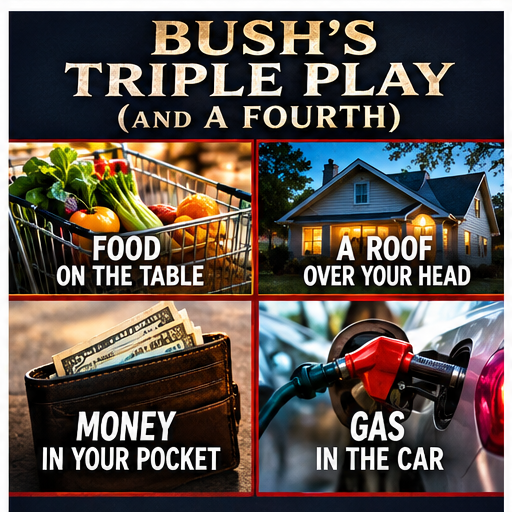
My understanding of political strategy was influenced by a personal conversation I recall having with President George H. W. Bush.
During that conversation, as I remember it, Bush described three essential conditions for maintaining public confidence and political stability:
Food on the table.
A roof over people’s heads.
Money in their pockets.
Three simple principles, but ones that reach into virtually every American household.
I have always regarded these principles as more than a description of economic prosperity. They represent a fundamental understanding of how Americans judge their government.
When families can afford to eat, maintain their homes, pay their bills, and enjoy some financial independence, they generally have greater confidence in their future.
When those conditions deteriorate, public confidence can deteriorate with them.
Bush understood that political stability was closely connected to economic security.
A president might achieve considerable success in foreign affairs, military operations, international diplomacy, or national economic development. But those achievements may carry little political weight with a family struggling to pay its mortgage or purchase groceries.
My recollection comes from a private conversation, and I believe I also discussed it in recorded interviews that have not yet been independently transcribed and verified.
Bush’s publicly articulated concept of a New World Order concerned international security and cooperation following the Cold War. My interpretation of his domestic economic observations is separate from that public foreign-policy doctrine.
What has remained with me is the simplicity of the principle.
Political confidence begins at home.
The Fourth Principle: Oil Prices and the Cost of Everything
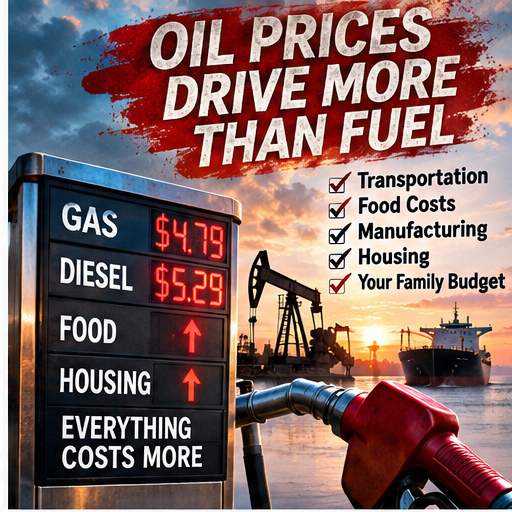
Over the years, I have added a fourth principle to the three economic priorities I recall President Bush describing.
Gas in the car.
At first glance, this might seem like a minor addition.
It is not.
Energy is fundamental to the operation of the American economy.
Oil and petroleum products influence transportation, agriculture, manufacturing, shipping, construction, food production, and the distribution of virtually everything Americans purchase.
When gasoline prices rise, families pay more to travel to work, transport their children, obtain medical attention, and conduct ordinary daily activities.
When diesel prices increase, farmers face higher operating costs, trucking companies pay more to move merchandise, and distributors pass additional expenses through the supply chain.
Those costs eventually reach the consumer.
The price of fuel therefore affects far more than the family automobile.
It influences the price of food on the table and the amount of money remaining in the household budget.
In that sense, my fourth principle directly influences two of Bush’s original three.
The war with Iran added another dimension to this relationship.
Military conflict, threats to petroleum infrastructure, and uncertainty surrounding shipping through the Strait of Hormuz can place substantial pressure on global energy markets.
Even when the United States produces significant quantities of petroleum domestically, American consumers remain exposed to international oil prices.
A military decision made thousands of miles from American shores can therefore become an economic problem at home.
Foreign policy does not remain foreign when its consequences reach the gasoline pump, the grocery store, and the family checking account.
That is why I believe energy affordability must be included among the fundamental economic conditions that influence American political stability.
The American Expectation of Comfort
Americans are, in many respects, a people accustomed to comfort.
Generations of economic development have created expectations of reliable transportation, adequate housing, plentiful food, accessible medical services, and a reasonable standard of living.
We expect our homes to be comfortable, our vehicles to operate, our stores to be stocked, and our incomes to support the necessities of everyday life.
As a society, we are not particularly tolerant of prolonged economic discomfort.
That is not necessarily a weakness. It is partly the consequence of living in a country where generations have worked to improve their standard of living.
But it carries significant political consequences.
Americans may accept sacrifice during a national emergency, a necessary war, or a period of economic difficulty when they understand the purpose and believe that the hardship will eventually end.
History demonstrates that Americans are capable of extraordinary sacrifice.
What they are less inclined to accept is a continuing decline in their standard of living without a convincing explanation, a clear objective, and a credible path toward improvement.
When gasoline becomes unaffordable, food prices rise, housing consumes an increasing percentage of household income, and medical expenses threaten family savings, citizens begin questioning those responsible for governing.
The reaction is not necessarily ideological.
A voter struggling to purchase groceries may be less concerned with whether an economic proposal is labeled capitalist, socialist, conservative, or progressive than with whether it offers a credible solution.
That creates an opportunity for political movements promising immediate economic relief.
When Americans become uncomfortable with their economic circumstances, they become increasingly willing to reconsider their political loyalties.
This is one reason I believe Bush’s three principles—and my fourth concerning fuel—remain so important.
Trump and the Bush Triple Play
In my interpretation, President Donald Trump lost sight of an essential political principle that George H. W. Bush understood: the American public ultimately judges its government by the economic conditions experienced in everyday life.
A president may point to industrial investment, corporate earnings, domestic energy production, employment statistics, military achievements, or stock-market performance.
Those accomplishments may be significant.
But national economic indicators do not always reflect the circumstances of an individual household.
A family struggling with food costs, rent, mortgage payments, insurance premiums, medical bills, and transportation expenses may not feel prosperous even when broader economic statistics appear favorable.
The distinction between economic performance and economic perception is politically important.
Trump’s administration pursued ambitious domestic and international objectives, including military operations involving Iran.
The administration presented its Iran policy as a matter of national security. Supporters viewed military action as necessary to confront strategic threats. Critics questioned its costs, risks, and broader consequences.
The conflict also introduced economic uncertainty, particularly in international energy markets.
Higher fuel costs can affect household purchasing power directly and can contribute to the cost of transporting and distributing essential goods.
Not every increase in petroleum prices can be attributed to a president. Global energy markets respond to production decisions, international demand, conflict, transportation disruptions, and numerous other factors.
Nevertheless, presidents are judged partly by the consequences of their decisions.
From my perspective, the political problem was that international objectives increasingly competed with the immediate economic concerns of American families.
A president may believe he is protecting America’s future while voters are asking whether they can afford their present.
That is where I believe Trump lost sight of the Bush Triple Play.
The question was not simply whether the administration could demonstrate economic achievements.
It was whether Americans felt sufficiently secure in their homes, their food budgets, their disposable income, and their ability to afford transportation.
Those concerns became central to the political environment surrounding the 2026 midterm elections.
The 2026 Midterms:
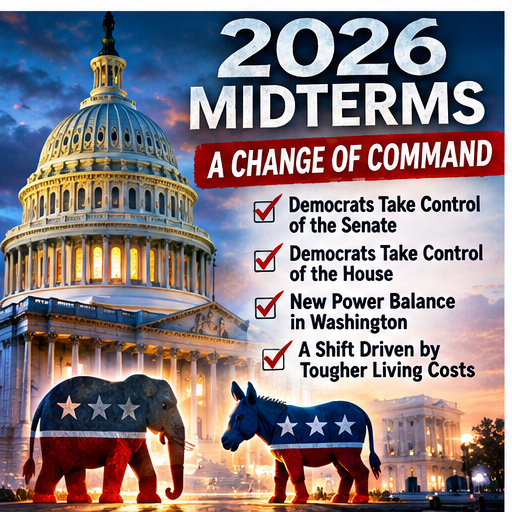

A Change of Congressional Power
The November 3, 2026 midterm elections marked a significant moment in American politics.
The reported election results indicated that Democrats had won control of both the United States House of Representatives and the Senate, reversing Republican congressional control and setting the stage for divided government during the final two years of President Trump’s term.
The newly elected Congress is scheduled to take office in January 2027.
That transition would affect legislative priorities, federal spending negotiations, congressional investigations, executive oversight, and the Senate’s role in presidential appointments.
But the importance of the election extends beyond the redistribution of congressional seats.
The results invite an examination of the economic and political circumstances that influenced voters.
Americans were confronting concerns about living costs, fuel prices, household purchasing power, and the economic consequences of international conflict.
Those conditions were consistent with the economic vulnerabilities I have described through Bush’s three principles and my fourth.
The election cannot be reduced to a single cause.
Voters consider candidates, party affiliations, national security, immigration, healthcare, economic performance, and numerous other issues when making their decisions.
Nor should the results be interpreted as a national endorsement of socialism.
The Democratic Party encompasses a broad range of economic philosophies, from relatively market-oriented policies to proposals associated with democratic socialism.
Nevertheless, the election demonstrated how political dissatisfaction can produce a substantial shift in congressional power.
When Americans believe their economic security is deteriorating, the party holding power becomes vulnerable.
In my judgment, the Trump administration underestimated the political consequences of the economic discomfort many voters were experiencing.
The outcome illustrates a recurring lesson of American politics: national achievements do not necessarily protect an administration when citizens believe their personal standard of living is under pressure.
Cause, Effect, and the Political Opening
The consequences of the midterm elections will extend beyond the immediate transfer of congressional control.
If the reported congressional results are confirmed, a president who previously enjoyed support from congressional majorities will face a legislature controlled by the opposing party.
Legislative negotiations may become more difficult. Congressional oversight will increase. Competing political philosophies will have greater opportunities to influence the national debate.
Most importantly for this investigation, economic dissatisfaction creates an opening for political movements offering alternative solutions.
When Americans struggle with the cost of living, proposals for subsidized housing, government-supported healthcare, public transportation, expanded social benefits, and greater economic intervention can become more attractive.
That does not mean the public has necessarily embraced socialism.
It means voters are searching for solutions.
The danger arises when political candidates make promises without adequately explaining their long-term financial consequences.
An expanded public program may provide meaningful benefits. It may also create permanent obligations requiring higher taxes, increased borrowing, or reductions in other government services.
Those consequences must be examined before the promises become policy.
The same standard must apply to politicians advocating lower taxes, reduced regulation, and greater reliance on private enterprise.
They must demonstrate that their policies can produce sufficient employment, investment, competition, and economic opportunity to improve the lives of ordinary citizens.
Neither ideology should be exempt from scrutiny.
The test should be whether government policies improve economic security without undermining the productive economy required to sustain it.
The central lesson I draw from the 2026 midterms is that political power ultimately depends upon the confidence of the people being governed.
Bush’s three principles described the basic conditions of household economic security.
My fourth recognizes the importance of energy in maintaining those conditions.
Together, they provide a practical framework for evaluating political leadership.
Food on the table.
A roof over people’s heads.
Money in their pockets.
And gas in the car.
When those foundations are threatened, Americans begin looking for political alternatives.
That search for alternatives is precisely where the debate over socialism, capitalism, government responsibility, and individual economic independence becomes most important.
The Dependency Question
The central issue running through these examples is the relationship between public assistance, economic opportunity, and political power.
Government assistance can protect citizens from poverty, illness, unemployment, and other hardships.
Public investment can create the infrastructure and human capital that private enterprise needs.
At the same time, poorly designed programs can impose unsustainable costs, weaken work incentives, encourage patronage, or concentrate economic influence in government institutions.
The difference depends upon program design, administration, transparency, financing, and results.
Citizens should not have to surrender political independence to receive public services.
Government benefits should not depend upon loyalty to a political party.
Public employment should not become a substitute for a productive economy.
And corruption should never be accepted as an unavoidable cost of governing.
The ultimate test is whether a system expands opportunity, protects essential needs, and allows people to build independent lives.
Closing Commentary — My Perspective
By Chip Tatum
I do not believe that socialism, by itself, works. Nor do I believe that unrestricted capitalism provides all the answers.
I believe the solution lies in a carefully balanced combination of private enterprise and clearly defined government responsibilities.
Government has an obligation to create and maintain an environment in which citizens can exercise certain fundamental economic and social rights.
The right to work. Government must maintain conditions compatible with employment stability, business investment, economic expansion, and the creation of meaningful jobs.
The right to affordable housing. Every citizen should have a reasonable opportunity to secure a roof over their head. Government must address the burdens of taxation, insurance, homeowners’ association fees, and other costs that make housing increasingly unaffordable.
The right to affordable sustenance. Working families should be able to purchase the food and basic necessities required to maintain a decent standard of living.
The right to education. Quality education and vocational training must be accessible and affordable, preparing citizens for productive employment and economic independence.
The right to security. Government must protect the lives, property, and freedoms of its citizens. Without security, neither economic development nor personal prosperity can flourish.
The right to affordable medical care. Every citizen should have access to affordable medical treatment, preventive care, prescription medications, and necessary hospital services. Government must maintain a healthcare environment in which insurance premiums, medical costs, and essential treatments do not place an unreasonable financial burden on individuals and families. No citizen should face financial ruin simply because they become ill.
I do not believe that government must own every business, provide every job, or control every aspect of economic life.
Quite the opposite.
Private enterprise, entrepreneurship, competition, and investment are essential to national prosperity.
But government must accept responsibility for maintaining the conditions in which those forces can succeed—and in which ordinary citizens can share in that prosperity.
Government Is Not a Commercial Enterprise
I do not believe governments are generally equipped to operate commercial enterprises as effectively as competitive private businesses.
Government operates through taxation, public budgets, political decisions, and public debt. Private enterprise must ordinarily survive through customers, revenue, investment, and the ability to meet its financial obligations.
When government nationalizes private businesses, it assumes responsibility not only for their employees but also for their operating expenses, capital requirements, debts, and commercial risks.
If those enterprises fail to generate sufficient revenue, their losses may ultimately become obligations of the taxpayer.
Nationalization has frequently produced disappointing results where political interference, inefficient management, inadequate investment, or weak financial accountability have undermined commercial performance. Although some publicly owned enterprises operate successfully, public ownership alone offers no guarantee of efficiency or sustainability.
Government ownership of commercial enterprises can also discourage domestic and foreign investment. Investors need confidence that private property will be protected, contracts will be honored, and businesses will operate under predictable laws and regulations.
When governments nationalize private enterprises without adequate safeguards, investors may hesitate to commit capital, expand existing operations, or establish new businesses. The resulting uncertainty can reduce economic growth, limit technological development, and restrict the creation of private-sector employment.
Some public enterprises serve legitimate purposes, particularly where essential infrastructure or natural monopolies are involved. But government ownership should not become a substitute for a healthy, competitive private economy.
A government that discourages private investment may ultimately destroy the very employment opportunities and tax revenues it needs to fulfill its obligations to citizens.
Government should concentrate on its essential responsibilities: establishing fair rules, maintaining infrastructure, protecting citizens, preventing corruption, and creating an economic environment in which private enterprise can invest, compete, grow, and employ people.
The responsibility of government is to make productive employment possible—not to replace the productive economy with a government payroll.
Government Responsibility, Revenue, and Accountability
In the United States, government operates through four principal levels: federal, state, county, and city. Each has distinct responsibilities, sources of revenue, and obligations to the citizens it serves.
The federal government collects income taxes, corporate taxes, payroll taxes, and other revenues.
State governments collect income taxes where applicable, sales taxes, fees, and other revenues.
County and city governments rely on various combinations of property taxes, local sales taxes, service fees, permits, and intergovernmental funding.
These revenue sources vary by jurisdiction, and some funds are transferred between levels of government. Nevertheless, every level controls public resources and must account for their use.
Other countries may organize government differently, but the same principle should apply: every level of government must work toward protecting citizens’ fundamental rights while managing public revenue responsibly.
Government must coordinate its responsibilities for employment, affordable housing, sustenance, education, medical care, and public security.
It must also recognize that excessive or poorly designed taxation can undermine the very affordability and economic growth it is supposed to protect.
Equally important is the control of corruption, including political favoritism, manipulated contracts, conflicts of interest, wasteful expenditures, and the diversion of public funds.
Citizens have a right to know how much revenue each level of government collects, where that money goes, which government is responsible for each public service, and whether the expenditures produce measurable benefits.
Public revenue belongs to the public. Government is its administrator, not its owner.
Every level of government must be held accountable for using those resources efficiently, transparently, and in the interests of the citizens who finance it.
Rights without accountability become political promises. Accountability without the protection of citizens’ rights becomes an empty administrative exercise.
Both are necessary.
My Conclusion
I believe government must provide the framework for prosperity, not become the sole source of prosperity.
A successful economic system must combine the productive power of private enterprise with responsible government oversight, essential public services, and meaningful protection of citizens’ fundamental needs.
It must also maintain strict accountability over public revenues and the officials entrusted with spending them.
The ultimate measure of good government is not how many people depend upon it for survival, but how many citizens have the opportunity to live securely, work productively, support their families, and build an independent future.
That is the balance I believe America must seek.
— Chip Tatum
The Pegasus File — Wake Up, World.